
"God made me for a purpose, but he also made me fast and when I run, I feel his pleasure."
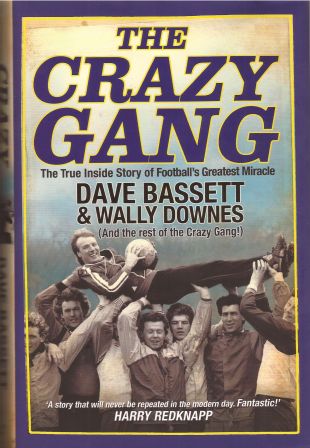
The crazy gang
Return to the book list for titles beginning with 't'.
Dave Bassett and Wally Downes, London Bantam Press, 2015. ISBN 9780593593076262
The book gives the inside story of the remarkable rise of Wimbledon FC from non-league to Division 1 (as today’s Premier League was called at that time) in nine seasons, 1977-1986. The authors are Harry Bassett, player and manager of Wimbledon, and Wally Downes, player, captain and assistant manager. However, the book also includes more than 20 sections of a few pages written by players and officials who were part of the journey. There is a remarkable agreement and synergy between the various contributions.
The big question is how did they achieve it? How did they become what Harry called “a bunch of Third Division footballers playing in the First Division at a Fourth Division ground”.
Few would disagree with goalkeeper, Dave Beasant (Wimbledon player 1979-88): “The basis of our success was the family atmosphere he [Bassett] helped create. It was all for one and one for all”. Harry says: “Camaraderie was the key”. Wally reinforces the point saying: “I would go ANYWHERE, ANYTIME and do ANYTHING for ANYONE of these people in this book!”
Wimbledon’s style of play was described as long ball but it was much more sophisticated than that. It was a deliberate strategy to maximize their ability and make life hard for the opposition. Watch any Premier League game today and one team kicks off, at walking pace, and knocks the ball around while the other team watches. As Nigel Winterburn (Wimbledon player 1983-87) explains, Wimbledon had a different approach! “We used to make teams kick it off- we used to pressure them SO high up and so hard that they would rather kick it out than try to play it out”. Pressure from the word go!
Glyn Hodges (Wimbledon player 1980-87) adds: “If we couldn’t outplay a side then we would outrun them and if we couldn’t outrun them then we would outfight them”.
Wimbledon had a statistician, as he is called in the book, and did a great deal of video analysis. Today this is common place but in the 1980s it was ground-breaking. Wimbledon scored a lot of goals from set pieces – not through luck but by practising them , over and over again. Glyn Hodges wrote: “We would be doing it for hours and hours”. Harry sent Wimbledon players on FA coaching courses so that they would understand football “from every angle”.
Lawrie Sanchez (Wimbledon player 1984-94) made an interesting point that at previous clubs if he had a bad game it was a nightmare but at Wimbledon he could still be effective: “if I kept doing as I was told, what we had planned and practised, then I would be helping the team”.
Players and management both say that the new methods were not popular at first. Both attest that when they started winning every week, everyone bought into it.
The book quotes a contemporary article from The Sunday Times, written by the respected writer (and former player), Eamon Dunphy: “Wimbledon are in the best English tradition, a team of honest men. Led by an outstanding manager who, like his team, has been patronized rather than appreciated”.
A good read, which will interest anyone old enough to remember The Crazy Gang. If you are not old enough, it will give you a fascinating insight into one of the strangest stories in English professional football.