
"I jump into a sand pit for a living"
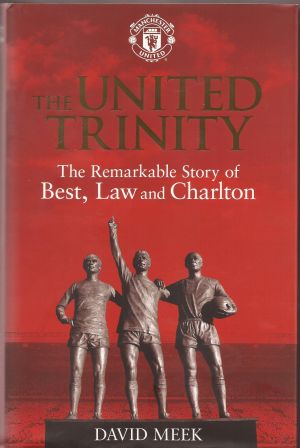
The United Trinity
Return to the book list for titles beginning with 't'.
David Meek, London, Simon and Schuster, 2013. ISBN 978-1-47112-955-1
Sub-title: The remarkable story of Best, Law and Charlton.
In 1967 I watched my first game at Old Trafford. I took a photo of Best, Charlton and Law standing together. Looking back it seems amazing to think of Manchester United having three such amazing players in the same team and I suppose equally amazing or puzzling that the team did not dominate English and European football as a result. The book, written by a man who reckons that he watched 2,000 Man U games, tells their story.
The book is full of anecdotes about the three players. One of its strengths is the evaluation of their talents:
Sir Matt Busby on Denis: “Denis Law.was the quickest thinking player I ever saw”.
Meek say of Best: “George’s greatest strength was that he didn’t have a weakness” arguing that he could have played in any position and been better than the normal Man U player in that position.
“Bobby Charlton was an idol without feet of clay, a sportsman supreme whose behaviour was exemplary both on and off the field”.
Meek gives an interesting evaluation of the trinity’s status: “The United fans respected the skills of Bobby Charlton, they revelled in the genius of George Best, but they worshipped Denis Law” and their epitaph: “Bobby Charlton, as you might expect, took the exit door marked ‘dignity’; Denis Law, again perhaps typically, departed with a touch of embarrassment and controversy to join rivals Manchester City, while George Best went, as he had lived, with drama and tragedy played out under the spotlight”.
People brought up on Manchester United’s dominance in the modern era may need to be reminded how the 1958 Munich air disaster decimated a great Manchester United team. There were real questions about whether the club, not especially wealthy at the time, could survive and regain its status as a top English club. That is the context of the creation of the team built around the trinity.
Another useful context for the modern reader, who is used to Premier League squad players being multi-millionaires, is the account of Warren Bradley (Manchester United and England 1958-62) being reluctant to give up his job as a teacher to play professionally for Man U as he felt teaching had better long term prospects or Albert Quixall, who worked for years in a scrap metal yard when his football career was over.
The book might have been better at half its length. At times it gives the impression of padding out. For example a chapter called “Jimmy and Bobby” has 2 pages of David Sadler commenting on George Best and then a comparison of Van Nistelrooy’s goal ratio with Denis Law’s.There is also a chapter “The next trinity” on Giggs, Scholes and Beckham – interesting but irrelevant to the subject of the book.
If you are old enough to remember the 1960s and 70s you will enjoy the book’s reminiscences. If not, you will profit from the education on football as it used to be.