
"there has only ever been one perfect man, the Lord Jesus, and we killed him. I only missed a putt."
The Austerity Olympics
Return to the book list for titles beginning with 't'.
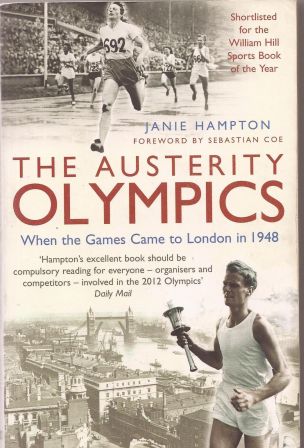
The Austerity Olympics, Janie Hampton, London, Aurum, 2008. ISBN 978184513 423 5
The book is an account of the 1948 Olympics. It has been painstakingly researched and gives a vivid picture of and insight into the conditions under which the last Olympics held in the UK took place.
We read of the challenge of feeding the Olympic teams in a period of food rationing. The primitive accommodation and the challenge of transport seem a million miles from what will happen in London next year.
The incredible story of Roger Bannister running to retrieve the GB flag from a car in the car-park for the opening ceremony is told. Oarsman, Michael Lapage, has happy memories of seeing the king at the ceremony, even if he did have to spend 4 hours trying to get shade from the sun as he waited for the ceremony to begin.
I was interested to read that – perhaps in remembrance of Eric Liddell, there was no competition on the middle Sunday. On that subject, British medallist Dorothy Manley, is quoted as saying: “I always thought my ability to run was a God-given talent, and nothing to do with me”.
The author quotes the Olympic motto: “The important thing in life is competing not conquering” and comments curiously, “although often attributed to Baron de Coubertin, had actually been based on a sermon given by the Bishop of Central Pennsylvania, Ethelbert Talbot, in St Paul’s Cathedral in 1908”. While it is true that de Coubertin attended and was influenced by the Bishop’s sermon, it was certainly he who championed the phase in the Olympic movement.
Inevitably the book is written from secondary sources which are quoted extensively. Generally this works but I found some of the long detailed reports on football matches a bit tedious. The author also shows up a lack of knowledge of football in commenting that the Indian football team “even managed to miss a penalty” as if that were a rarity.
Overall a fascinating book.