
"Football is not a matter of life and death, it is more important than that."
Bounce
Return to the book list for titles beginning with 'b'.
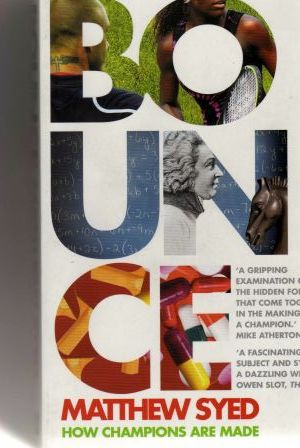
(How Champions are made), Matthew Syed, Fourth Estate, 2010-11-07 ISBN 978-0-00-735052-0
The basic thesis of the book is that it is not natural talent but opportunity and hours of practice, which determine whether someone reaches the top in sport. “The aim of the first part of this book is to convince you that … talent is not what you think it is; that you can accomplish all manner of things that seem so far beyond your current capabilities as to occupy a different universe”. (Page 12)
The argument starts from the author’s own experience of starting to play table tennis aged 8 when he had “a brilliant older brother to practise with, had been trained by one of the top coaches in the country, had joined the only twenty-four-hour club in the county, and had practised for thousands of hours by their early teens” He goes on:
“We like to think that sport is a meritocracy – where achievement is driven by ability and hard work – but it is nothing of the sort. Think of the thousands of potential table champions not fortunate enough to live in Silverdale Road, with its peculiar set of advantages”. Page 8
Quick reaction times are an essential skill in sport. These, Syed argues, are not natural ability but an acquired skill based on experience of years of practice, which enables the person to recognize and interpret the data better than you or I.
Is Federer a natural? he asks “No, Federer’s advantage has been gathered from experience: more precisely, it has been gained from a painstaking process of encoding the meaning of subtle patterns of movement drawn from more than ten thousand hours of practice and competition”. (Page 30)
Wayne Gretzky’s skill as an ice-hockey player is an ability to “discern the game’s underlying pattern and flow, and anticipate what’s going to happen faster and in more detail than anyone else”. (Page 47).
In chapter 2 he argues that Beckham, Tiger Woods, Williams sisters etc reached the top by endless practice not innate talent.
The importance of his thesis, he argues, is that if we believe it is about natural talent, we will quickly give up. If it is about opportunity and practice then every one of us has the potential to succeed.
In a chapter called The Placebo effect he looks at the impact of religious faith. Using Mohammed Ali and Jonathan Edwards as examples, he concludes: “The key point in all this is that the power of the mind is exercised through the medium of belief, and it doesn’t matter whether the belief is true or false or how the delusion is created so long as it is created successfully.” (Page 147). One wonders here whether Syed is looking for vindication of his own spiritual journey from Christian to agnostic here.
The importance of self-belief is developed. He refers to Tiger Woods whose “Tigerspeak” is not the truth but is intended to reinforce his mindset.
Matthew Syed has the advantage in writing about the subject where he has been there and done it. He describes his experience of choking in the Olympics “an imposter had taken over my body” (Page 169-70)
In an analysis of winning and losing, he quotes Victoria Pendleton’s reaction to winning as feeling lost and her comment that is sometimes easier to finish second than to win. Syed continues “During my table tennis career, there were few things more terrifying than getting my hands on a coveted prize. A defeat offered such a pleasing variety of emotional options: vengefulness, stoicism, anger, resignation, sadness, exasperation. But the metaphysical hollowness that often accompanies a long-desired triumph is something that nobody can prepare you for”. (Page 194-95)
The final chapter of the book, “Are blacks superior runners” (Page 238ff) largely argues that the answer is “no”. While there are many top black African runners, there are also many countries in black Africa, which have never had top runner. The success of Kenyan runners, he argues, is not inborn but based in the fact that as children many of them ran miles to school.
The book is a fascinating read and argues strongly in defence of its thesis, quoting experts in many fields. I am not qualified to evaluate the analysis. In many ways the arguments are compelling but I suspect that the answers are a bit more complex.